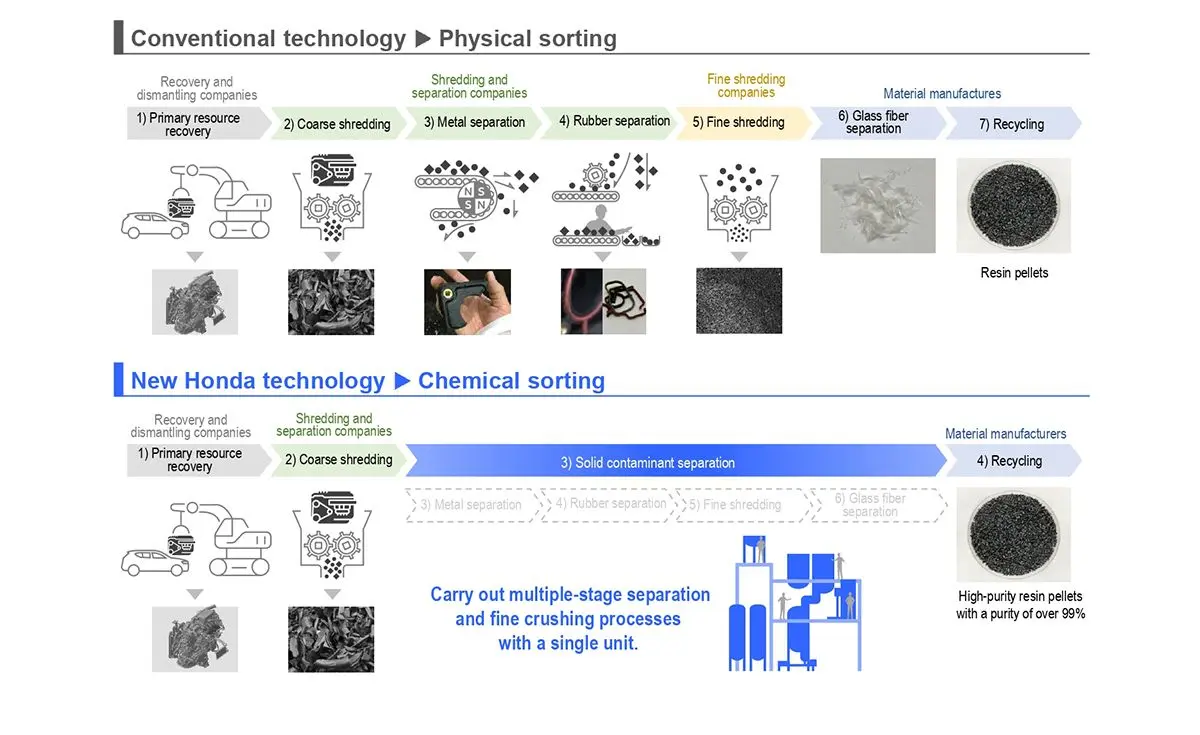
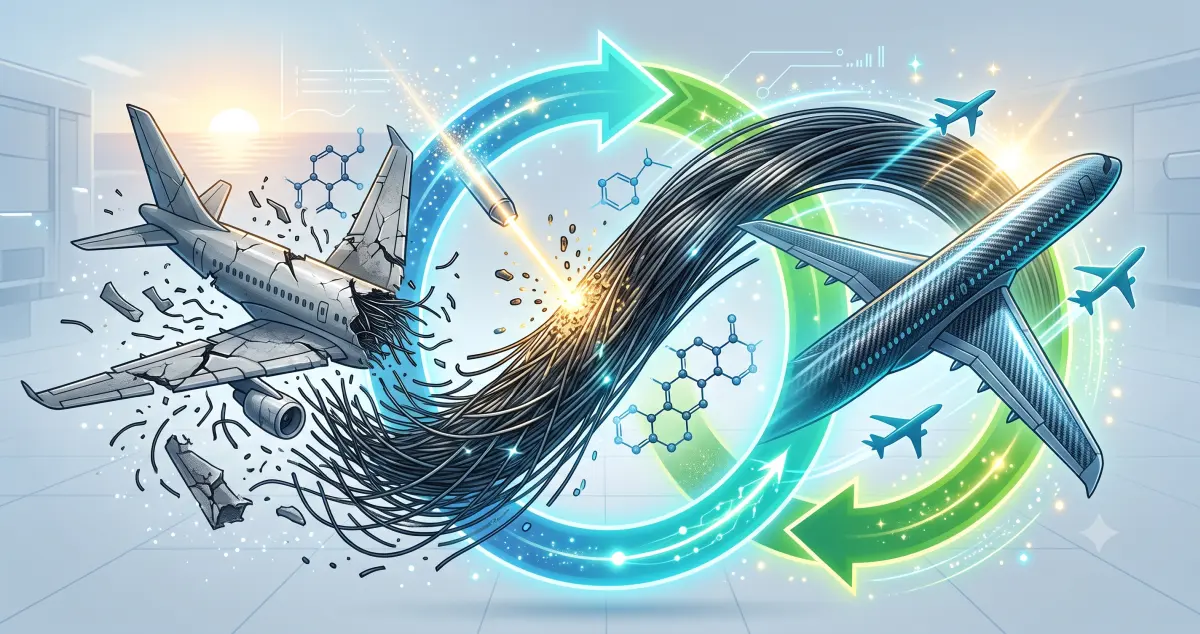
Honda R&D announced in September 2025 that it has developed a new solid-contaminant separation technology called “Chemical Sorting” to extract high-purity resin from waste plastic parts derived from end-of-life vehicles. The company will build a pilot facility with a maximum processing capacity of 350 tons/year in 2026 and aims for practical application around 2029.
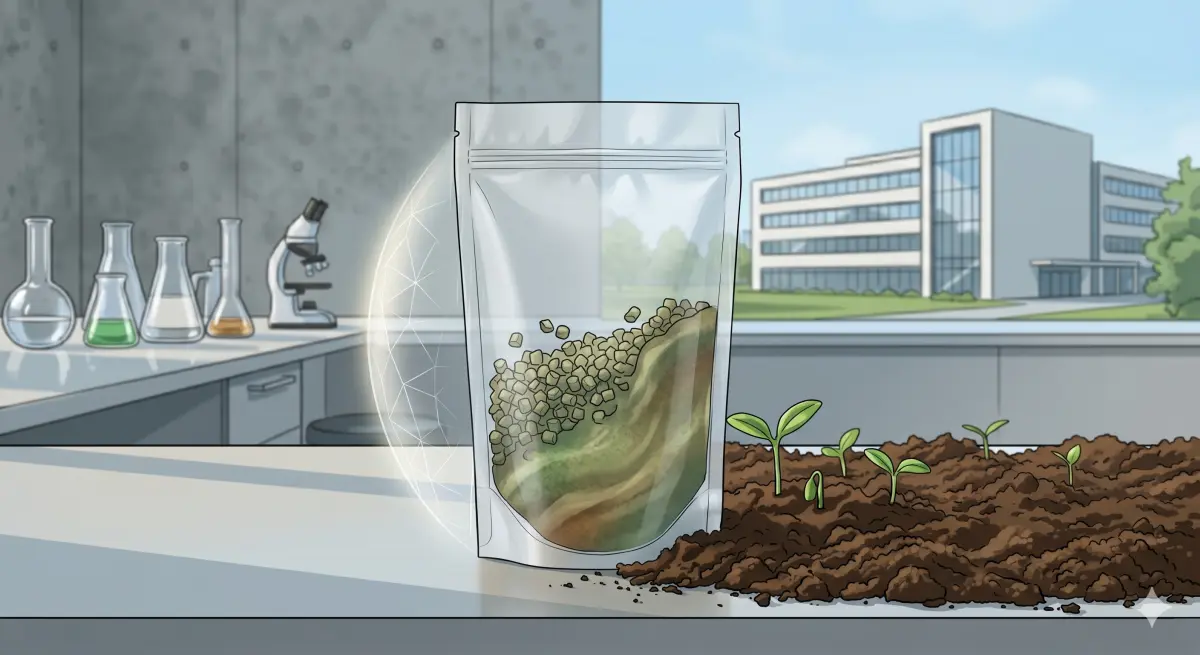
The new technology dissolves resin in a solvent to remove solid contaminants, achieving high-purity recycled plastics.
Waste plastic parts from end-of-life vehicles typically contain solid contaminants such as metal inserts, rubber hose pieces and gaskets, and reinforcing materials like glass fibers. Honda’s chemical sorting method improves the solid-contaminant separation rate from the conventional approximately 80% to more than 99%.
Honda’s approach uses coarse-mesh filters for millimetre-sized contaminants and centrifuges for micrometre-sized contaminants, enabling handling of various sizes in a continuous industrial process.
By eliminating the need to adjust removal-filter specifications for each contaminant size, the process reduces maintenance and filter replacement. Establishing a continuous process capable of stable large-scale operation expands the range of recyclable plastic parts and enhances economic feasibility and scalability.
The high-purity plastic extracted (purity > 99%) can undergo mechanical or chemical recycling and be reused as automotive material in a closed-loop recycling system.
Resource circulation is a key focus area in Honda’s mobility strategy. Honda states that this newly developed technology is also expected to be applicable to other materials, including engineering plastics. The company will continue its recycling-related research and challenge the development of products made with 100 % use of sustainable materials.
In the automotive industry, the push toward reuse of recycled plastics and circular material flows is growing. For example, Toyota Gosei collaborated with Isono to develop recycled plastic containing 50% polypropylene recovered from ELVs. They announced plans to use this material—which possesses performance equivalent to new materials and has been practically applied to interior parts requiring high quality standards in various models, including the Toyota Camry. Furthermore, companies like Nissan Motor are advancing the development of chemical recycling technology to liquefy waste plastics derived from Automobile Shredder Residue (ASR), with various companies engaged in research and development of new technologies.
These trends indicate that Honda’s Chemical Sorting technology aligns with and may support broader industry transitions toward circular-plastic use.