Does it ever feel like there are an unlimited number of things made of plastic? Commercial plastics — a category of synthetic or semi-synthetic materials — are used in everything from packaging to construction, automotive to electronics.
What are commercial plastics? Let’s take a look.
When was plastic first used commercially?
Plastic was introduced commercially in the mid-19th century. Parkesine, the first synthetic plastic treated with chemicals and made from cellulose, was presented as an ivory and tortoiseshell replacement at the 1862 Great International Exhibition in London. Unfortunately, it was brittle and expensive to produce, leading to limited adoption.
In 1869, celluloid became the first commercial plastic to achieve widespread success. Designed to replace ivory in billiard balls, celluloid also originated from cellulose but was considerably more versatile and durable.
What are the 7 types of plastic vs what are the 4 main types of plastic?
These are both classifications (i.e., way plastics are organized or grouped) but they have different functions. Essentially, the 4 main types are a subset of the 7 types.
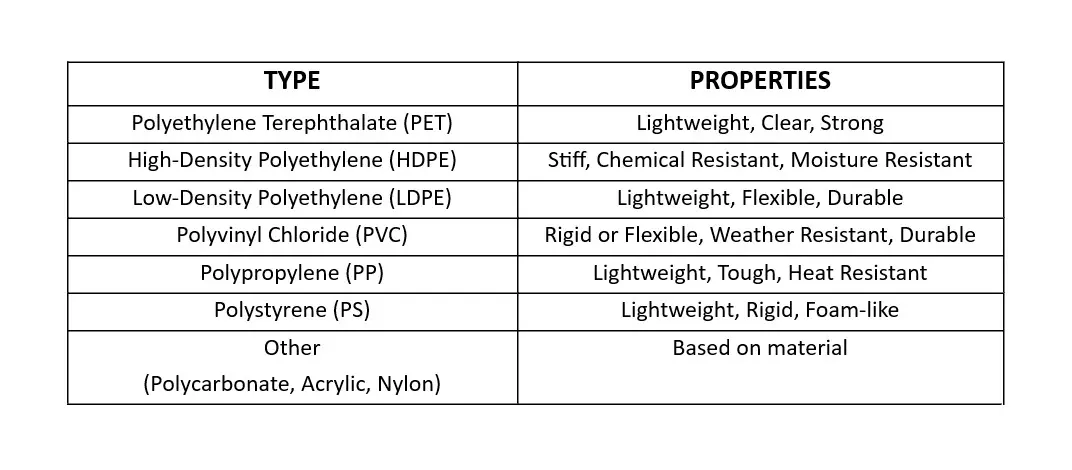
- 7 types of plastic: Categorized based on the Resin Identification Codes (RIC), which categorize for recycling
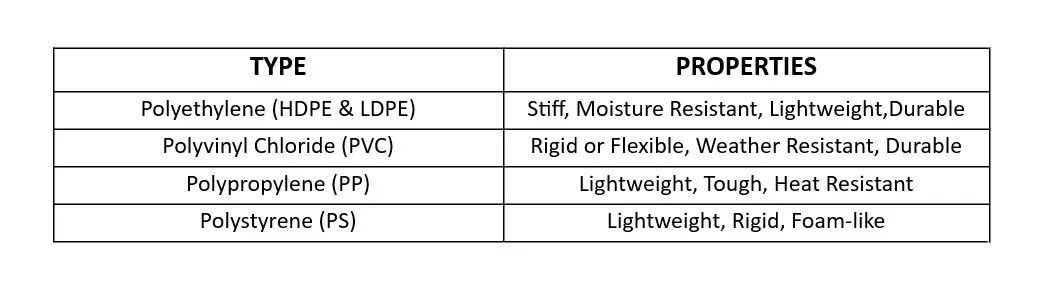
- 4 main types of plastic: Classified by general use based on prevalence and versatility
The charts below break down the two classifications and their properties.
7 types of plastic (RIC)
4 main types of plastic
The most common commercial plastic is polyethylene (PE) because of its versatility and low cost. PE is available as low-density polyethylene (LDPE) and high-density polyethylene (HDPE). While both are moisture-resistant and lightweight, HDPE is a more durable plastic overall. Polyethylene plastic examples include:
- HDPE
o Milk containers
o Detergent bottles
o Toys
o Piping
o Cutting boards
o Trash bins
o Outdoor furniture
- LDPE
o Bubble wrap
o Plastic bags
o Squeeze bottles
o Food wrap
o Container lids
o Tubing
o Insulation