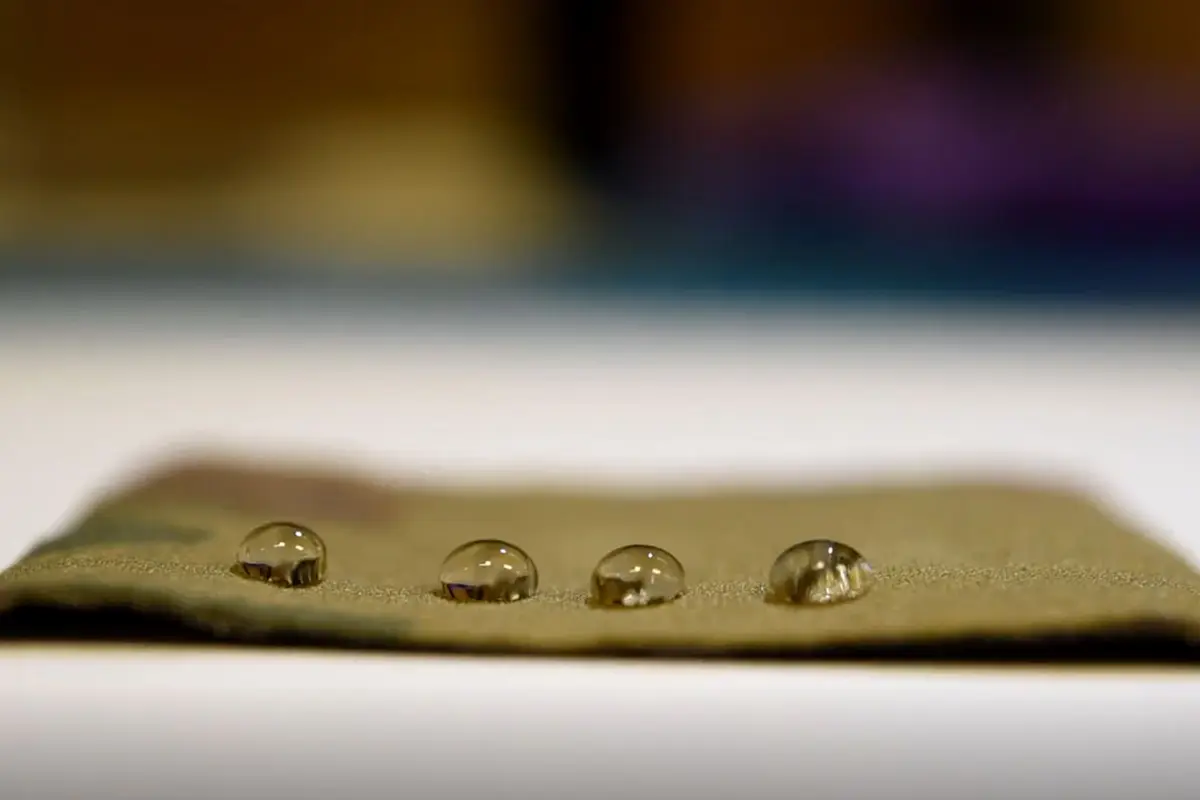
A new coating developed by researchers at the University of Toronto could offer a safer alternative to non-stick chemicals such as standard PFAS, which are commonly used in cookware and other applications.
“The research community has been trying to develop safer alternatives to PFAS for a long time,” says Professor Kevin Golovin (MIE), who leads the Durable Repellent Engineered Advanced Materials(DREAM) Laboratory at the University of Toronto’s Faculty of Applied Science & Engineering.
Teflon and other PFAS (per- and polyfluoroalkyl substances) have long been used to make cookware, packaging,and fabrics resistant to water, oil, and grease alike. But these “forever
chemicals” persist in the environment and can accumulate in the human body, potentially causing significant health and environmental risks, with longer-chain PFAS are typically regarded as more harmful than shorter-chain variants.
Researchers at U of T Engineering have developed a new substance that repels both water and oil as effectively as standard non-stick coatings but contains much lower amounts of PFAS and uses the shortest possible PFAS (-CF3), which does not bioaccumulate.
The team used polydimethylsiloxane (PDMS), commonly known as silicone, as the base for their new material. “PDMS is often sold under the name silicone, and depending on how it’s formulated, it can be very biocompatible — in fact it’s often used in devices that are meant to be implanted into the body,” said Golovin.
However, PDMS alone does not match PFAS in terms of its ability to repel oil and grease. To overcome this problem, MIE PhD student Samuel Au developed a new chemical technique that the team calls nanoscale fletching.
“Unlike typical silicone, we bond short chains of PDMS to a base material — you can think of them like bristles on a brush,” says Au. To improve their oil-repelling power, the team added the minimal PFAS unit—a single carbon bearing three fluorine atoms—was grafted to the bristle tips.
“If you were able to shrink down to the nanometre scale, it would look a bit like the feathers at the back end of an arrow, where it notches to the bow. That’s called fletching, so this is nanoscale fletching,” Au explained.
The coated fabric achieved a rating of 6 on the American Association of Textile Chemists and Colorists oil-repellency test using oil droplets. That’s on par with many commercial PFAS-based coatings.
“While we did use a PFAS molecule in this process, it is the shortest possible one and therefore does not bioaccumulate,” said Golovin. “Our hybrid material provides the same performance as what had been achieved with long-chain PFAS, but with greatly reduced risk.”
The team hopes to collaborate with manufacturers to scale up the process and bring the product to market. Meanwhile, research continues.
“The holy grail of this field would be a substance that outperforms Teflon, but with no PFAS at all,” Golovin said. “We’re not quite there yet, but this is an important step in the right
direction.”
The study is published in the journal Nature Communications.