What the Ethylene Shake-Up Means for Buyers and Competitors of Japanese Basic Chemicals
If you source basic chemicals or commodity resins from Japan, the landscape of suppliers will be fundamentally reshaped between now and 2030—and the changes are already backed by signed agreements, not merely proposals.
Four major consolidations are now underway, three of them under signed agreements. Maruzen Petrochemical will shut down the standalone cracker it operates in Chiba in fiscal 2026 and consolidate production at Keiyo Ethylene, its joint venture with Sumitomo Chemical. Idemitsu Kosan will halt operations at its Chiba cracker in July 2027 following a scheduled turnaround, transferring production to Mitsui Chemicals' adjacent cracker, which the two companies will subsequently operate as a joint venture. ENEOS, whose restructuring plans are less advanced, has begun evaluating the closure of the 448,000-ton-per-year cracker at its Kawasaki refinery by the end of fiscal 2027, leaving a single cracker in operation at the site. Meanwhile, in January 2026, Mitsui Chemicals, Mitsubishi Chemical, and Asahi Kasei signed a basic agreement to restructure operations in western Japan. Under the plan, the cracker at the Mizushima complex in Okayama—part of an industrial site that has operated since 1964, the year of the first Tokyo Olympics—will be shut down by fiscal 2030, with production consolidated at Mitsui's Osaka Petrochemical plant in Takaishi. In May, the three companies agreed to proceed based on a 45%/45%/10% ownership structure for Mitsui, Mitsubishi, and Asahi Kasei, respectively, reflecting each company's product allocation, although the definitive joint-venture agreement has yet to be signed.
Taken together, these changes will reduce Japan's ethylene production capacity from twelve crackers with approximately 6.2 million metric tons of annual capacity to eight crackers with around 4.4–4.5 million metric tons, according to the Japan Petrochemical Industry Association. This represents a reduction of nearly 30% and marks the most significant restructuring of Japan's upstream petrochemical industry in a generation. The question is not only why this is happening, but also what it means for companies that buy from—or compete with—Japanese chemical producers.
Why Now, After Decades of Discussion
Japanese petrochemical consolidation has been discussed—and repeatedly postponed—for more than three decades. What ultimately forced action was a combination of long-term structural pressures and a sudden external shock that made further delay untenable.
It begins with a structural imbalance. A wave of new ethylene crackers in China has flooded the Asian market with basic chemicals, pushing operating rates at Japanese ethylene plants below the approximately 90% threshold generally regarded as necessary for profitability every month since August 2022. This streak now spans nearly four years, making it by far the longest on record. Throughout 2025, operating rates remained in the mid- to high-70% range. Compounding the challenge is a longer-term decline in domestic demand, driven by lower plastic consumption and the growing substitution of virgin resins with recycled materials. Japan's ethylene production fell below five million metric tons in 2024 for the first time since 1987. At the same time, the country's production assets are aging. According to Manabu Chikumoto, President of Mitsubishi Chemical and, since July, Chairman of the Japan Petrochemical Industry Association, even Japan's newest ethylene cracker has been in operation for roughly 40 years, resulting in rising maintenance costs and a scale of operation that is no longer globally competitive.
Then came the external shock. Approximately 80% of Japan's naphtha demand is effectively supplied by the Middle East, and what the Japanese trade press described as the de facto closure of the Strait of Hormuz beginning in February 2026 transformed that dependency from a strategic concern into an operational crisis. At one point, naphtha prices nearly doubled. Rather than shut down crackers—which are costly and time-consuming to restart—producers deliberately reduced operating rates to the minimum levels their facilities could safely sustain. The national operating rate fell to 68.6% in March, the lowest level since data collection began in 1996 and below the previous record set during the 2009 global financial crisis. It declined further to 67.3% in April and, according to preliminary figures, to 66.5% in June, even after a U.S.–Iran ceasefire memorandum helped restore naphtha prices and buyers postponed purchases in anticipation of further price declines.
The most acute phase of the disruption now appears to have passed. Upon assuming the chairmanship of the Japan Petrochemical Industry Association in July, Chikumoto stated that feedstock procurement had stabilized and expressed expectations that operating rates would gradually recover. He has since indicated that he does not expect a return to the severe conditions seen in March and April. Even so, any recovery to the low-70% range would merely restore operating rates to their pre-crisis norm—and that "normal" had already represented nearly four consecutive years of unprofitable operations.
Distinguishing between these two sources of pressure is critical for strategic planning. The prolonged deterioration since 2022 reflects structural issues stemming from China's capacity expansion and weakening demand, making cracker consolidation a rational long-term response. By contrast, the record-low operating rates seen in 2026 were triggered by feedstock supply disruptions—an issue that consolidation alone cannot resolve. Indeed, reducing the number of crackers from twelve to eight may leave the industry with less operational flexibility should another major supply disruption occur. Mitsui Chemicals' chairman has stated openly that Japan's petrochemical sector will ultimately consolidate into only a handful of major players. The restructuring now underway provides the clearest indication yet that this vision is becoming reality.
The Part Most Coverage Misses: This Is a Strategic Pivot, Not Simply Plant Closures
It would be easy to interpret these developments as a straightforward industrial decline, with Japan shutting down petrochemical assets it can no longer operate competitively. That interpretation, however, overlooks the broader strategic transformation now taking place—and risks leading companies to the wrong conclusions.
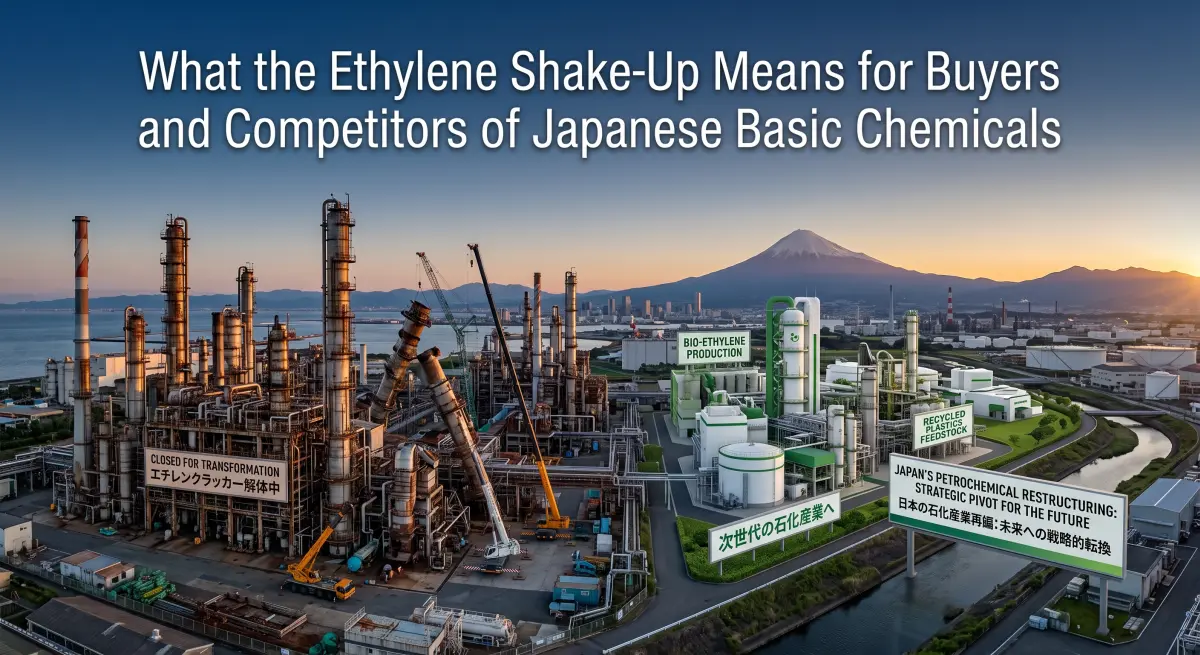
Two parallel shifts are occurring alongside the cracker closures. First, the surviving producers are investing heavily in low-carbon feedstocks. The three-company venture in western Japan is supported by Japan's Ministry of Economy, Trade and Industry (METI) in developing bioethanol-to-ethylene production using Asahi Kasei's Revolefin technology, with commercial-scale production targeted for 2034. Second, companies reducing upstream production are redirecting investment toward circular materials businesses. For example, Idemitsu Kosan began commercial production of chemically recycled oil at its Chiba facility in April 2026, supplying recycled feedstock for polyethylene and polypropylene production. Because demand for these recycled materials is increasingly supported by regulatory frameworks, they are less vulnerable to price volatility than conventional virgin resins.
Perhaps most importantly for manufacturers purchasing intermediate chemicals or specialty materials, shutting down an ethylene cracker does not mean an industrial site ceases operations. Mitsubishi Chemical has stated that it will continue producing downstream derivatives at its Mizushima complex after ethylene production ends, sourcing ethylene from external suppliers instead. As the company has emphasized, shutting down the cracker represents only one stage in a broader transformation. The company's long-term competitive focus lies in higher-value intermediates and specialty chemicals. In other words, while upstream ethylene production is being consolidated, downstream manufacturing is being strategically repositioned rather than abandoned.
What This Means for You
If your company sources Japanese basic chemicals or commodity resins, expect a supplier landscape characterized by fewer, larger producers operating at higher utilization rates. In principle, this should improve industry economics and reduce the likelihood of prolonged margin pressure. At the same time, however, it also means less production redundancy. Companies should map their current procurement against the facilities expected to remain in operation by 2030: Mitsui's Osaka Petrochemical complex in Takaishi, Mitsui's Chiba operations, Keiyo Ethylene in Chiba, and one of ENEOS's two crackers at Kawasaki. While some details remain subject to change—particularly ENEOS's plans, which are still under evaluation—the overall direction of the industry's restructuring is becoming increasingly clear. Any supply chain dependent on ethylene production at Mizushima warrants discussion well before 2029. It is also worth asking a question that was far less pressing a year ago: Where does your supplier source its naphtha, and how did its operations respond to the supply disruptions between February and June 2026?
If your organization has sustainability targets, Japan's petrochemical industry is positioning itself to become part of the solution. The companies emerging from this restructuring are investing in bio-based and recycled feedstocks, with demand increasingly supported by environmental regulations. For companies planning to procure certified low-carbon or recycled polyethylene (PE) and polypropylene (PP), Japan's major producers are seeking to establish themselves as long-term qualified suppliers. Engaging with suppliers during this capacity build-out may provide strategic advantages that become less accessible once commercial production reaches full scale.
If your company competes with Japanese chemical producers, it is important to recognize the strategic objective behind the consolidation. The restructuring is intended to raise utilization rates and restore pricing discipline in commodity chemicals while allowing major producers to redirect capital toward specialty chemicals and circular-material businesses. A smaller upstream industry should therefore not be interpreted as a weaker competitor, but rather as the foundation for a more disciplined and potentially more competitive downstream sector.
What to Watch Next
The announced cracker closures represent only the most visible phase of Japan's petrochemical restructuring. Equally significant will be the consolidation of downstream derivatives and intermediate chemicals—what Mitsubishi Chemical has described as the industry's "second act"—as these developments will have the greatest impact on buyers of specialty chemicals and engineering materials.
Over the next 18 months, four developments merit particularly close attention: whether the definitive agreement for the western Japan joint venture is finalized under the proposed 45%/45%/10% ownership structure; which derivative businesses are consolidated and where production is ultimately concentrated; whether efforts to diversify naphtha procurement beyond the Middle East continue after feedstock prices stabilize; and how rapidly bio-based feedstock and recycled-material projects progress from pilot-scale initiatives to full commercial production. Together, these indicators will provide the clearest view of how Japan's petrochemical industry is evolving beyond its current restructuring.
This article is an independent editorial analysis by PlaBase English and does not constitute investment advice. The company strategies and industry developments discussed are based on publicly available disclosures, company statements, and media reports available as of August 2026.