When polyamide (PA) — known as nylon — was commercially introduced at the New York World’s Fair in 1939, it was billed as “Thinner than spider silk, stronger than steel.” While it was a revolutionary claim at the time, in the decades since its release, nylon has proven itself indispensable and withstood the most demanding tests.
Where did polyamide come from?
Valued for their strength and lightweight, natural fibers like silk were used extensively in textiles during the early 20th century. However, the onset of World War II caused a significant disruption in the silk supply and highlighted the critical need for alternative materials. Led by chemist Wallace Carothers, DuPont had already been researching synthetic fibers. In 1935, Carothers discovered PA66, which was commercially introduced in 1939.By 1942, IG of Germany began producing PA6. Both were initially used as synthetic fibers for textiles, but in the early 1950s, they found their way into plastics.
What is polyamide?
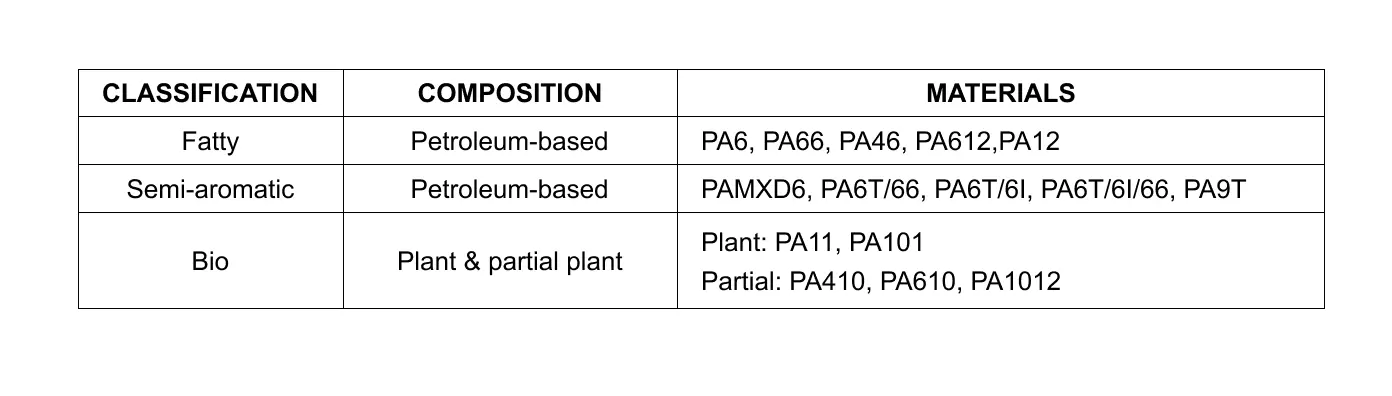
Polyamide resins are linear polymers in which monomers are linked by polymerizing ε-caprolactam, amide molecules derived from petroleum. The most used PAs are PA6 and PA66, but many others have been developed. Each polyamide is named PA XX, with the XX indicating the chemical raw material used.
PA material is classified into three types:
What are PA polyamide properties?
What’s great about nylon is that it has excellent mechanical properties and is easy to process, making it popular in a variety of fields beyond synthetic fibers. Popular features include (but are not limited to):
- Tensile strength: Though it’s lightweight, some PA (aramid) has five times the strength of steel
- Impact resistance: The hard surface makes it less prone to wear and has ten times the
abrasion resistance of cotton - Thermal stability: Withstands very high temperatures without breaking down
- Versatility: Can be processed into fibers, films and shapes using injection or extrusion molding
What is PA plastic used for?
When nylon was introduced in 1939, people saw it as a replacement for women’s stockings and military parachutes. Thanks to continuing research and the properties mentioned above, today nylon is popular across industries worldwide. You’ll find nylon PA in things like:
- Consumer Goods: kitchen utensils, sporting goods, guitar strings and food film
- Safety: Firefighting gear, space suits, helmets, bulletproof vests
- Automotive: Fuel lines, seat belts, accelerator pedals
- Military: Fiber optic cables, parachutes, tactical gear, field tents
- Textiles: Carpet, rugs, clothing
- Electronics: Cable ties, insulation
- Medical: Sutures, surgical instruments
- Construction: replacement for asbestos and steel wires
Polyamide FAQs
Q: What is polyamide material?
A: It is a synthetic polymer used in plastics and textiles.
Q: Is polyamide stretchy
A: Yes, PA is stretchy to a certain point.
Q: Does polyamide shrink?
A: It will shrink under some conditions.
Q: Is polyamide toxic?
A: Under normal conditions and in its final form, nylon PA is not toxic. However, exposure to high temperatures or during manufacturing may emit harmful fumes if not appropriately handled.
Q: Explain the difference in polyamide vs polyester
A: Both are made up of repeating units, but polyamide (nylon) uses amide bonds while polyester uses ester bonds. Nylon is generally stronger than polyester and absorbs more moisture, however polyester is more heat and chemical resistant.
Q: Is nylon a plastic?
A: Yes, nylon is a thermoplastic because it can be molded into countless shapes.