From your air fryer to your automobile, your smartphone to your curling iron, plastic products that heat up are everywhere. But how is it possible? How does the high heat not melt your favorite devices?
Meet polyphenylene sulfide plastic or PPS plastic.
This engineering plastic (a resin made to handle mechanical stress and high temperatures) is in high demand as manufacturers look to replace metals in industrial and consumer applications.
Let’s learn more about PPS.
The history of polyphenylene sulfide plastic
As industry and manufacturing evolved in the mid-20th century, calls for materials that performed under extreme conditions got louder. Edmond Louis Bayer, a chemist at Phillips Petroleum Company, answered that call with the development of polyphenylene sulfide plastic in the early 1960s. By 1965, Bayer had patented PPS material and began commercially producing it under the name Ryton®. With the expiration of the Phillips Petroleum patent in 1984, numerous companies entered the market, including Kureha Corporation — a Japanese company producing PPS plastic under the trade name Fortron®.
What is PPS plastic?
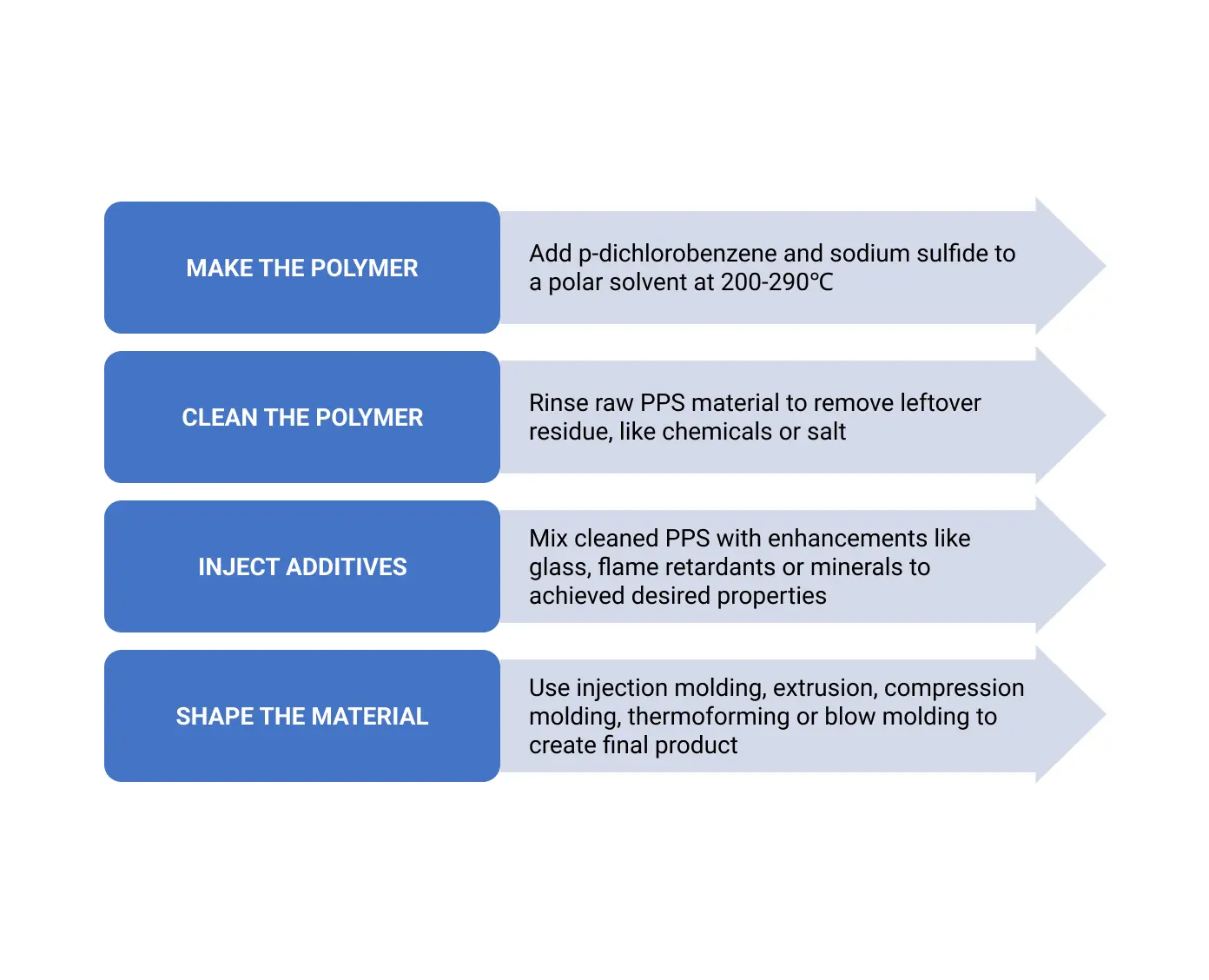
PPS is a high-performance thermoplastic polymer with a straight-chain structure of alternating bonds between phenyl groups (benzene rings) and sulfur (S). Regardless of the manufacturer, the steps include:
How many types of PPS plastic are there?
Based on the polymerization method, there are three types of PPS:
- Cross-linked: heat-treated in the presence of oxygen during the polymer manufacturing process
- Semi-cross-linked: Limited heat treatment to bond some of the chemical chains
- Linear: No heat treatment resulting in a removal of the cross-linking structure
Although there are slight differences in physical properties and moldability, they are collectively referred to as PPS. There are several ways to manufacture a PPS polymer, including the Phillips Petroleum process (also called the Ryton PPS process), the Macallum process and the Dow Chemical process. Polymerization reactions, catalysts and final product properties are responsible for production differences. Today, the Phillips Petroleum/Ryton PPS process remains the most popular method.
What are the characteristics of PPS plastic material?
PPS plastic is widely popular for its ability to withstand harsh environments. Its features include:
- High strength and rigidity
- Thermal stability (difficult to burn)
- Resistance to water, organic solvents, oil and other chemicals
- Dimensional stability
- Easy to process
- Electrical insulation properties
- Reduces abrasion, friction and wear
What is PPS plastic used for?
Though the use of PPS material varies by industry, it is a popular choice in fields that require materials with thermal stability, chemical resistance and mechanical strength.
Due to its long-term heat and high chemical resistance, the automobile industry heavily relies on PPS as manufacturers look to replace metal parts, phenolic resin and nylon-based materials. Ten years ago, PPS was found in about 30% of vehicles; today, that is up to nearly 60%. Gasoline vehicles use 400 to 500 grams of PPS per vehicle, while hybrid vehicles (HVs) use three to four times that amount — a figure that is expected to increase.
In addition to automobiles, PPS is also used in:
- Electronics: Connectors, switches, office equipment, smartphones and tablets
- Consumer goods: Hair styling tools, cooking utensils, small appliances
- Construction: HVAC systems, pipe lining, insulation
Polyphenylene sulfide FAQs
Q: Can PPS plastic be recycled?
A: PPS can be recycled but is not as common as other plastics. PPS recycling is a more complex process because of its high-performing characteristics.
Q: Is PPS plastic biodegradable?
A: No, it is not biodegradable.
Q: Is PPS material food safe?
A: Whether PPS is deemed food safe is based on the safety standards set by individual countries. In many cases, PPS safety is graded on additives used, grade of the material and production methods.
Q: What are the disadvantages of PPS?
A: While there are countless reasons to use PPS, it does have some drawbacks like brittleness at low temperatures, high material cost, environmental concerns, sensitivity during processing and limited elasticity.