Moving Parts: Issue 3
How China's anti-dumping duties redrew the POM sourcing map by plant location
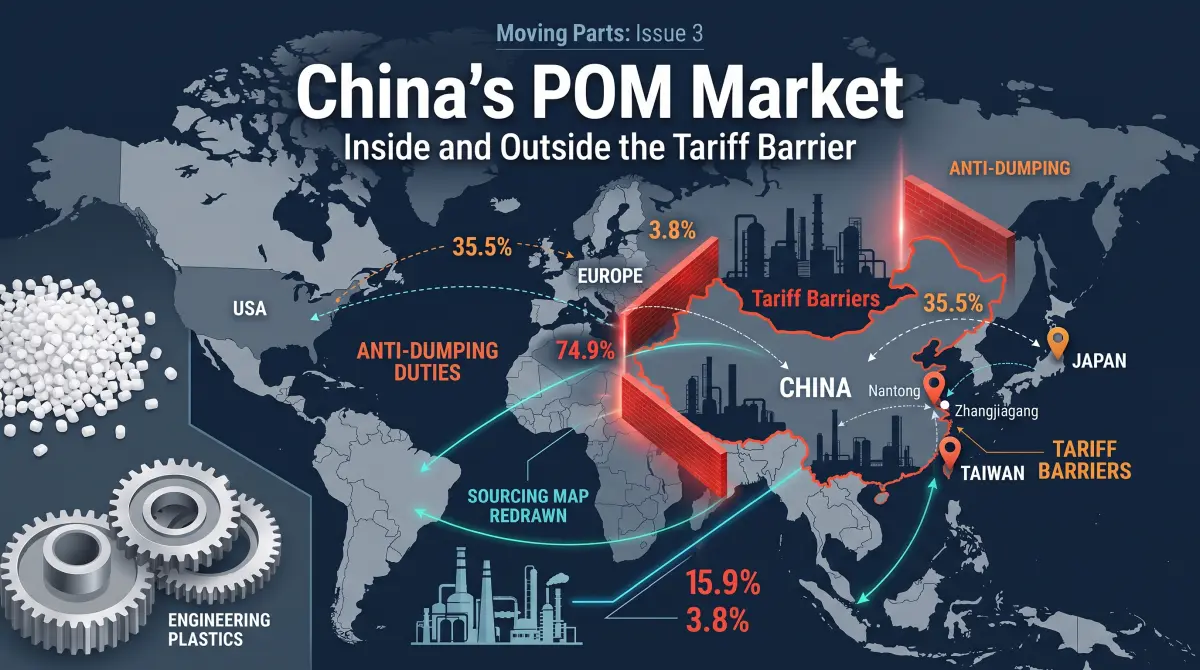
In 2025, China imported 288,000 metric tons of polyacetal (POM), down 27.4% from the previous year. The decline continued in January and February 2026, when imports fell 36.6% from the same period a year earlier. The largest factor is the anti-dumping duty that China's Ministry of Commerce (MOFCOM) imposed on May 19, 2025, on POM copolymer originating in the U.S., the European Union, Taiwan and Japan. The duty runs for five years. The import statistics also include products outside the scope of the measure, but the direction is clear.
This development is not just one episode of trade friction. The story is that the sourcing map for engineering plastics has been redrawn not only by material performance but also by where plants are located.
What Happened
The duty rates differ by origin and by company. The rate is 74.9% for U.S. product and 34.5% for EU product. Japanese product is generally subject to 35.5%, with Asahi Kasei alone at 24.5%. Taiwanese product carries a general rate of 32.6%, but Formosa Plastics received a company-specific rate of 4.0% and Polyplastics Taiwan a rate of 3.8%.
For the same POM copolymer, the rates differ by a factor of nearly 20. The company-specific rates reflect the dumping margins that MOFCOM determined for each company that responded to the investigation.
In April 2026, Polyplastics transferred its engineering plastics business to its parent company, Daicel, through a corporate split. Polyplastics then renamed itself HPP Holdings and became a holding company. In August, MOFCOM approved the transfer of the duty rates. Daicel inherits the 35.5% rate, and Daicel HPP Taiwan inherits the 3.8% rate. Before approving the transfer, MOFCOM examined whether production facilities, capacity, customers and sales channels had changed substantially through the reorganization. If a shipment from Taiwan still carries the former company name, it is subject to the 32.6% rate for all other Taiwanese companies. That rate is approximately 8.6 times the inherited rate.
Why Now
The investigation began in May 2024, just after the U.S. sharply raised tariffs on Chinese electric vehicles (EVs) and semiconductors. However, the core of the issue lies in supply and demand within China.
In December 2025, the China Synthetic Resin Association issued a formal appeal (changyishu) calling for the healthy development of the POM industry. Ten companies signed it, including Chongqing Yuntianhua Tianju New Materials, Yankuang Lunan Chemical and CHN Energy Ningxia Coal Industry. According to the association, domestic capacity, including plants in operation, under construction and planned, is expected to reach 1.51 million metric tons per year. Demand in 2025 was only approximately 950,000 tons. Future capacity is therefore approximately 1.6 times current demand. The association also cited high import dependence for high-end products as a problem. The document is an industry association's own admission of overcapacity.
The anti-dumping duty works as a mechanism that protects an industry with this overcapacity from price competition with imports. In 2025, imports fell by approximately 109,000 tons from the previous year. Exports rose 29.6% to 38,000 tons, but the increase was only 9,000 tons. The main destination for domestic product is not overseas markets but the gap in the domestic market that imports left.
What Much of the Coverage Misses
Much English-language coverage framed this case as a U.S.-China conflict story: "China imposes 74.9% on U.S. plastics." From a sourcing perspective, a different issue appears.
POM polymerized in China is not subject to this duty. China also has a separate measure in place since 2017. POM copolymer from South Korea, Thailand and Malaysia is subject to anti-dumping duties as well, and China extended those duties for five years in 2023.
When the two measures are combined, the rate differs by shipping origin even within the same company. For Daicel, the rate is 35.5% from its Fuji plant in Japan, 8.0% from Malaysia, 3.8% from Kaohsiung in Taiwan and 0% from Nantong in China. Even for the same brand, the landed price in China depends on which plant the product ships from.
Daicel's new Nantong plant started commercial operation in November 2024 at a scale of 90,000 tons. The Mitsubishi Gas Chemical group holds a 30% stake in the operating company, and the plant also produces Mitsubishi Gas Chemical's brand. As of October 2025, Polyplastics said it planned to start a second phase of 60,000 tons in fiscal 2027 (April 2027–March 2028). Asahi Kasei also produces POM in Zhangjiagang, Jiangsu province.
Celanese has no POM polymerization facilities in China. Its U.S. product faces 74.9%, its German product 34.5% and shipments from Korea Engineering Plastics (KEP), its joint venture in South Korea, 30.0%. The facility outside both measures is the plant at Ibn Sina, its joint venture in Saudi Arabia, with an annual capacity of 50,000 tons.
However, differences in location do not lead directly to a change of supplier. For automotive and electrical and electronics parts, a change of production plant requires customer requalification, even for the same grade. This series has called this structure a qualification moat. Here, the moat works to slow the buyer's switch.
Competition continues inside the tariff barrier as well. In February 2025, Hualu Engineering & Technology, part of China National Chemical Engineering Group, succeeded in a pilot test of high-end POM. In November that year, Hualu signed a framework agreement with China Coal Ordos Energy Chemical toward industrialization. Domestic producers with excess capacity are moving to capture the remaining high-end segment.
What This Means for You
For buyers. Check not only which POM brand you use but also at which plant it was polymerized. Even from the same supplier, product from Japan and product from China have different cost structures. The importer pays the anti-dumping duty, and import value-added tax (VAT) is charged on a price that includes the duty. Whether the terms are delivered duty paid (DDP) or cost, insurance and freight (CIF) changes who bears this cost.
Also check the product form. The final determination explicitly excludes homopolymer and modified POM that fall under the same tariff code. The determination defines the covered product by numerical values such as density, melting point and tensile modulus. However, China's customs authorities decide whether an individual grade falls outside the scope, so it is better not to rely only on a supplier's explanation.
For manufacturers in China. The economics of local sourcing have changed significantly over the five-year duty period. Commodity grades face continued downward price pressure from overcapacity, while suppliers of high-end grades remain limited. This is a time for manufacturers to separate their sourcing strategies for commodity and high-end grades and to allow time for requalification when they switch.
For competitors. The assumption that suppliers can maintain volume in China by exporting commodity copolymer from Japan is unlikely to hold, at least until May 2030, when the duty period ends. Even then, China may extend the measure. The measure on South Korea, Thailand and Malaysia was in fact extended. Suppliers without local polymerization will need to show, through their grades and the reliability of their supply, value that exceeds the cost of the duty.
What to Watch
First, the progress of China's domestic production of high-end POM. The time from pilot testing to commercial production is the time this structure has left.
Second, whether similar measures spread to other products. In January 2026, China launched an anti-dumping investigation into dichlorosilane from Japan. In a preliminary determination on Sept. 7, it found dumping margins of 80.8% to 99.2%. Collection of cash deposits began the next day, Sept. 8. China's measures against Japan in the materials sector are starting to extend beyond POM.
Third, whether the appeal restrains investment. The first answer has already come. In July 2026, the board of Yunnan Yuntianhua approved a plan for its subsidiary Chongqing Yuntianhua Tianju New Materials, a signatory of the appeal, to build a new high-end POM copolymer plant in Chongqing with an annual capacity of 100,000 tons. The investment is approximately 1.86 billion yuan, and construction is reportedly scheduled to begin in December 2026. Yunnan Yuntianhua already has 90,000 tons of capacity and is one of the largest producers in China. The very company that signed the appeal decided to expand half a year later. If the volume that the domestic market cannot absorb grows, exports, which are small for now, will become the next issue.
This article is an independent editorial analysis by PlaBase English and does not constitute investment advice. The company strategies and industry developments discussed are based on publicly available disclosures, company statements, and media reports available as of October 2026.