Moving Parts — Edition #4
Asahi Kasei was scheduled to end production of acrylic resin (PMMA) at its Kawasaki Works in Japan in September 2026. The company plans to continue sales until September 2027. For buyers who use this resin, however, the real deadline may come earlier than that date.
What Happened
In May 2025, Asahi Kasei, a Japanese chemical group that is separate from the brewer Asahi Breweries, decided to exit four businesses: MMA monomer, cyclohexyl methacrylate (CHMA), the Delpet™ and Delpowder™ acrylic resins, and SB latex. MMA (methyl methacrylate) is the monomer used to make PMMA. Under the plan, MMA production and sales end in September 2026. Acrylic resin production ends in September 2026, and sales end in September 2027.
According to trade press reports, Asahi Kasei's capacity is about 100,000 metric tons per year of MMA and about 40,000 tons per year of PMMA. The four businesses had combined net sales of about 34.6 billion yen (about $220 million) in the fiscal year ended March 2025.
As reasons for the exit, the company cites a weaker supply-demand balance caused by large capacity expansion in China, together with high feedstock costs. Its plants have operated at low rates, and the company judged the situation to be "structural and irreversible."
Asahi Kasei is not alone. Over the past three years, Japan's major chemical companies have cut their MMA and PMMA businesses again and again.
- Mitsubishi Chemical ended MMA production by the acetone cyanohydrin (ACH) process at its Hiroshima Plant in July 2024 but continues MMA production there by the C4 process. Trade press reports put the ACH line at 107,000 tons per year and the C4 line at 110,000 tons. In January 2025, the company canceled a planned 350,000-ton-per-year MMA plant in Geismar, Louisiana. In March 2026, it announced the sale of its stake in KMC, its MMA joint venture in Taiwan, to its partner CPDC, a Taiwanese petrochemical company. The plant's capacity will remain in the market.
- Sumitomo Chemical cut its MMA capacity in Singapore by about 80% and its PMMA capacity there by about 70% in September 2024. As a result, the group's total PMMA capacity fell by half, from 200,000 to 100,000 tons per year.
- Kuraray announced in June 2024 that it would halve its MMA capacity in Niigata (67,000 tons per year) from July 2025 and stop external sales of MMA. It will also reduce its capacity for PMMA molding materials.
Asahi Kasei's exit is the most recent of these cuts. However, Japan's PMMA supply is not disappearing. Mitsubishi Chemical, Sumitomo Chemical and Kuraray continue their MMA and PMMA businesses, at a smaller scale.
Why Now
Three forces are behind this move.
The first is oversupply in Asia caused by capacity additions in China. Asahi Kasei, Mitsubishi Chemical and Sumitomo Chemical all cite it as a reason for their exits or cuts.
The second is feedstock cost and supply instability. In March 2026, the de facto closure of the Strait of Hormuz stopped naphtha supply from the Middle East. In the same month, Sumitomo Chemical's Singapore subsidiary declared force majeure on MMA shipments. At its November 2 earnings briefing, Sumitomo Chemical said that its force majeure in Singapore had not yet been lifted.
The third is a specialty pivot: companies are shifting their focus away from commodity products. Asahi Kasei plans to convert its Kawasaki Works into a base for ion-exchange membrane and hydrogen-related businesses. Sumitomo Chemical is focusing on specialty and high-value products in its acrylics business. Mitsubishi Chemical says it will concentrate production at its most competitive sites.
What Most Coverage Misses
This move is often reported as Japanese companies retreating under pressure from Chinese producers. The September 2027 end of sales has also been reported since the exit announcement. What is easy to miss is that this date may not be the real deadline for buyers.
After production stops, the volume available for sale is limited. What actually constrains buyers is when the last-time buy window closes and how much volume each customer is allocated. That deadline could come earlier than September 2027.
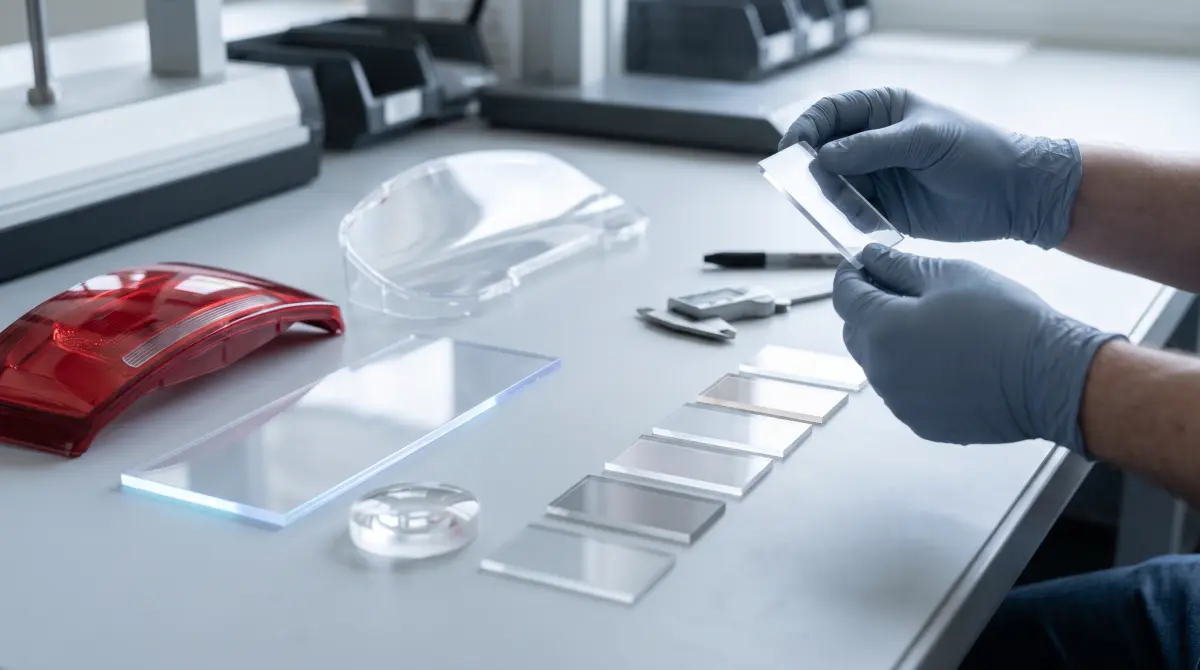
Time is limited because of the applications. The main uses of Asahi Kasei's acrylic resin include automotive rear lamp covers and meter covers, optical lenses, light guide plates and lighting. All of these are parts where transparency, weather resistance and appearance quality matter. Changing the material often requires evaluation and approval by the customer, such as a carmaker's approval of the part.
Transparent PMMA parts such as lamp covers and light guide panels often need customer approval before a material change. (AI-generated illustration)
Alternative PMMA is available in the market. The problem is not volume. It is the time needed before an alternative can be used at the required specifications.
Earlier in this series, in our Teardown of Ajinomoto's ABF, we introduced the idea of a "qualification moat." It describes a structure in which a customer's processes are designed for a specific material, so the customer rarely switches to another material. While a supplier stays in the market, this moat protects the supplier. When the supplier leaves, the same structure works in the opposite direction and becomes a constraint on the buyer.
The second point is shared feedstock risk. In the first week of March 2026 alone, at least eight Asian petrochemical producers declared force majeure, according to S&P Global Commodity Insights. The cause was a common feedstock shock. Because Asian producers share the same feedstock risk, adding more suppliers is not enough protection on its own.
What This Means for You
Buyers of Asahi Kasei's acrylic resin. First, confirm the grades you use, your annual volume and the last-time buy terms. Then build a schedule backward from your deadline that covers each step: candidate selection, trials, performance testing, customer approval and the switch to mass production. Candidate selection will start with a side-by-side comparison of property data for grades from several suppliers. PlaBase English lists PMMA grades and offers a property search for this comparison.
Buyers of other Japanese or Asian PMMA. Ideally, diversify your second source by both region and production process (such as the C4 or ACH process). A name on your supplier list is not enough. A second source protects you against a supply disruption only when you have an approved grade and a secured volume.
Competing PMMA suppliers. If Japanese customers start to evaluate alternatives, time-limited demand may appear. However, these customers need specific optical and appearance quality. Without support for trials and evaluation, and a clear statement of available capacity, it will be difficult to win this demand.
What to Watch Next
- Sumitomo Chemical's force majeure in Singapore: As of November 2, it had not been lifted. When will it be lifted?
- Alternative adoption before September 2027: Which grades will be selected for automotive lamps and light guide plates?
- Asahi Kasei's last-time-buy terms: Has the company told customers when it will stop accepting orders for its acrylic resin, and how it will allocate the remaining volume? That date, not September 2027, sets the real deadline.
Moving Parts covers one ongoing development in Japan's materials industry in each edition. If this development raises a supply chain question for your business, please leave a comment. We read every comment. To see the next edition in your feed, follow PlaBase on LinkedIn.
This article is an independent editorial analysis by PlaBase English and does not constitute investment advice. Company positions described here are drawn from public disclosures, company statements, and media reports as of November 2026. Yen amounts are converted at 157.47 yen per U.S. dollar, the Federal Reserve H.10 rate for October 30, 2026.