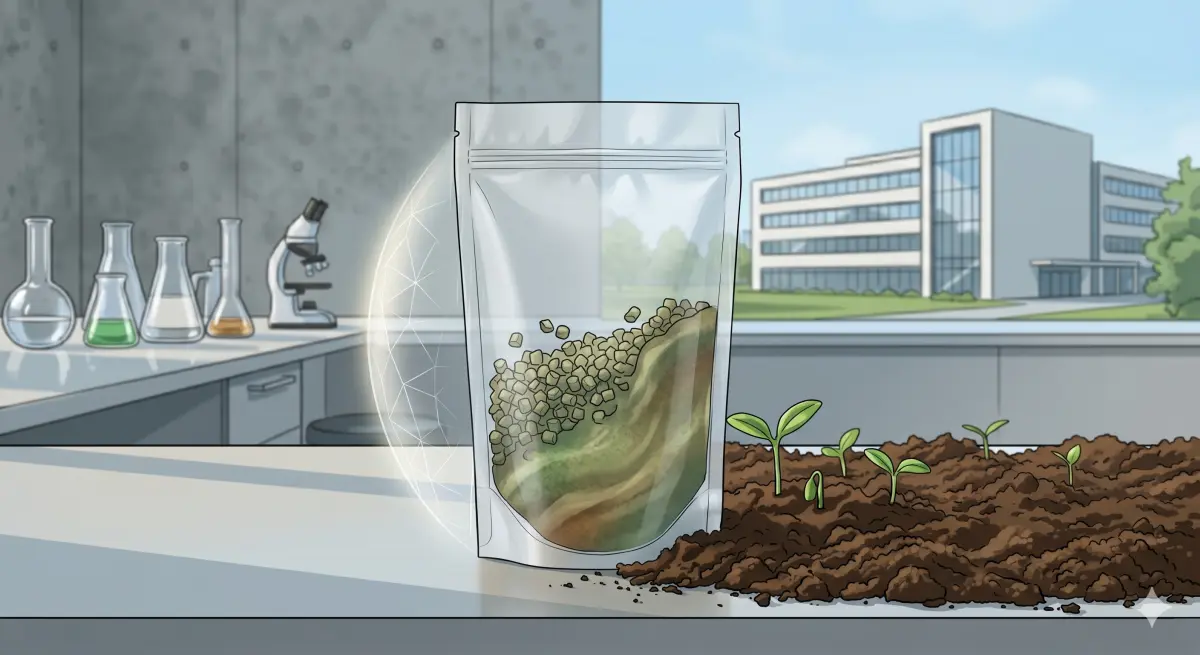
On April 29, 2026, BASF expanded its biodegradable ecovio® portfolio with the launch of new grades designed for flexible packaging applications in the fast-moving consumer goods (FMCG) sector. The new materials combine biodegradability with high oxygen and water-vapor barrier performance, enabling more sustainable packaging solutions without compromising the functionality and protection offered by conventional packaging materials.
Combining Barrier Performance with Compostability and Circularity
In addition to the biodegradability already offered by the ecovio® portfolio, the new grades provide enhanced barriers against oxygen and water vapor. Certified as home compostable, they enable packaging performance and end-of-life options to be tailored to specific applications and regulatory requirements. The materials are suitable for extrusion coating, film extrusion, and lamination, and can be used to create both single-layer and multilayer barrier structures.
Plastic packaging made with the new grades can be organically recycled through both industrial and home composting systems. According to BASF, the materials do not leave persistent microplastics behind, and are broken down by microorganisms into water, carbon dioxide, and biomass. BASF states that the grades are certified home compostable; note that no harmonized EU standard for home compostability yet exists, and certification in this field currently rests on private schemes. For paper- and paperboard-based packaging, fibers can be recovered through existing paper recycling streams. When food contamination limits conventional recycling, composting offers an additional end-of-life option through organic recycling.
Challenges and Regulatory Pressures in Sustainable Packaging Development
Packaging for food, beverages, healthcare products, and other consumer goods requires effective barrier properties to prevent moisture and oxygen ingress and maintain product quality throughout its shelf life. However, the use of multilayer structures composed of different materials to enhance barrier performance has traditionally posed challenges for recycling.
The packaging industry is entering a period of significant transformation, driven in large part by evolving regulations, particularly in Europe. The European Union's Packaging and Packaging Waste Regulation (PPWR) entered into force in February 2025, with phased implementation beginning in August 2026. From January 2030, packaging placed on the EU market must meet defined recyclability grades, and plastic packaging must contain minimum levels of recycled content. It is worth being precise about where compostable materials sit within that framework, because the PPWR is often read as a tailwind for them. It is not, at least not broadly.
The Regulation makes recyclability the default: from February 2028, only a narrow list of formats - permeable tea and coffee bags, soft single-serve units, and sticky labels on fruit and vegetables - must be industrially compostable, with home compostability required only where a Member State chooses to mandate it. Other biodegradable plastic packaging must be designed for recycling and must not disrupt existing recycling streams. Compostable packaging is also excluded from the recycled-content targets, meaning it earns no credit against them.
Read that way, the PPWR does not open the door to compostables so much as define the room they are allowed to occupy - and that room is where recycling does not work. Flexible packaging soiled with food is the clearest case: it is difficult to recycle, and it frequently contaminates the streams it enters. Paper and paperboard packaging is another, where a compostable coating can replace a conventional plastic layer while the fibers still return through the existing paper recycling route. Those are precisely the applications BASF is aiming at.
Responding to Growing Demand for Sustainable Packaging
For Japanese manufacturers and material suppliers serving global markets, adapting to the growing demand for more sustainable packaging solutions has become a commercial requirement, not a preference.
With the PPWR in mind, TOPPAN is developing mono-material barrier packaging designed to improve recyclability. The company has launched SMARTS, a sustainability-focused packaging brand, and offers products such as GL BARRIER, a transparent barrier film positioned as an alternative to aluminum foil. Meanwhile, Kuraray’s EVAL, an ethylene-vinyl alcohol (EVOH) resin, is widely used in food, cosmetics, and medical packaging applications due to its excellent gas-barrier properties.
From biodegradable and compostable materials such as BASF’s ecovio® to mono-material packaging solutions designed to enhance recyclability, a variety of approaches are emerging across the industry. As sustainability requirements continue to evolve, these innovations are expected to play an increasingly important role in advancing circular packaging systems.